Boat Cover vs Shrink Wrap: Which Is Better for Winter?
Boat cover vs shrink wrap for winter: snow, ventilation and mildew, winter access, seasons of use, waste and cost factors, and how storage and climate decide it.
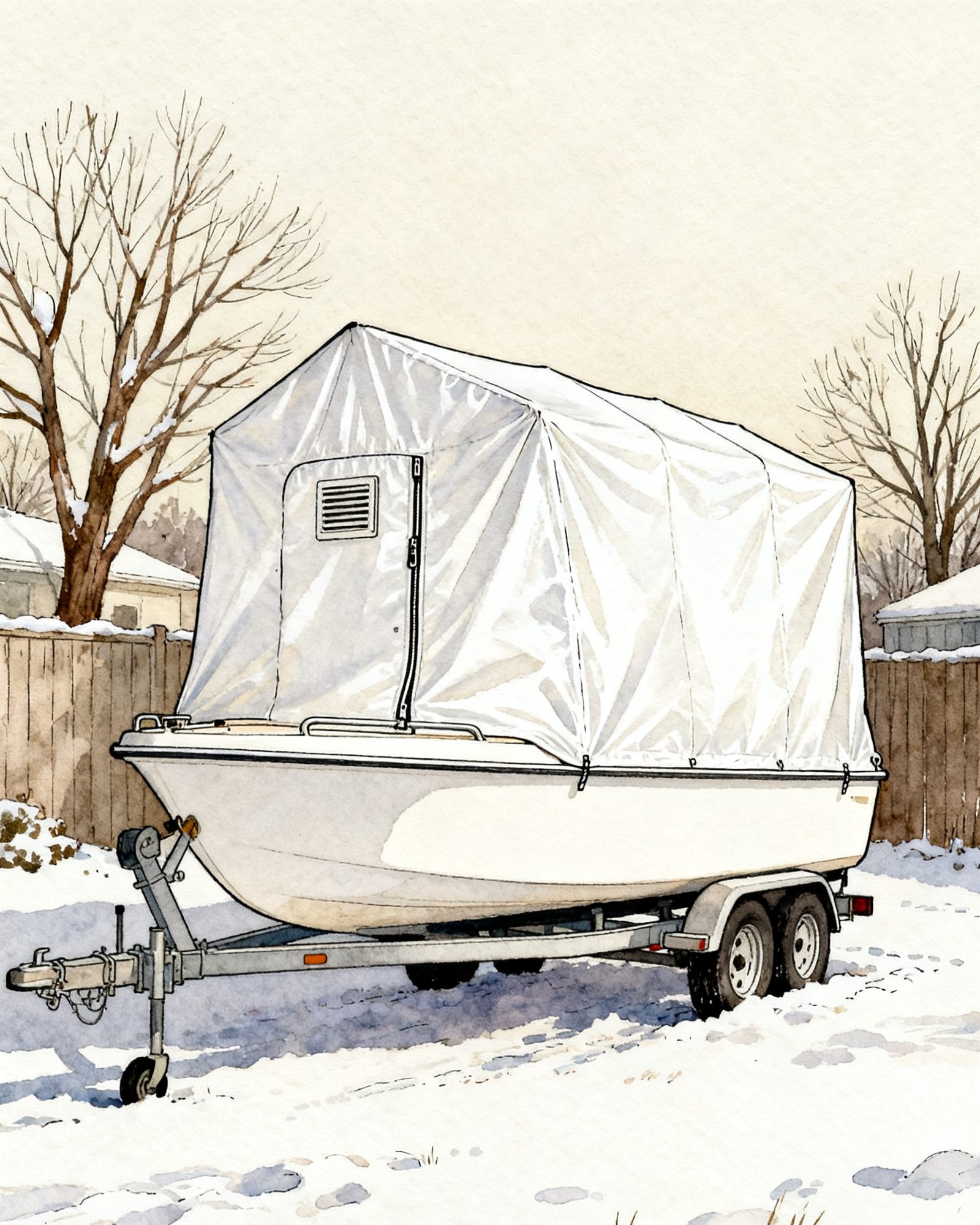
For a boat that spends a snowy winter outdoors, professionally applied shrink wrap is usually the stronger choice: it is shrunk tight over a sloped frame so snow and rain run off, and someone else does the work. Discover Boating, the boat industry’s consumer site, calls a professional wrap “by far the best way to cover a boat for winter storage”. A good fitted winter cover is the better choice when you keep the boat for many years, want to get aboard during the winter, store it under a roof or in a mild climate, and are willing to give it a strong support frame and check on it after every storm. The cover is bought once and reused; the wrap is bought every year and thrown away or recycled every spring.
Boat cover and shrink wrap side by side
| Fitted winter cover | Shrink wrap | |
|---|---|---|
| Fit | Made for a boat type or for your boat; settles over the winter | Shrunk tight to this boat |
| Snow and rain | Sheds them only over a strong frame or poles | Strapping and a ridge frame shed them |
| Ventilation | Needs vents so air circulates beneath it | Vents added after shrinking; plastic does not breathe |
| Getting aboard in winter | Relatively easy to get under | Through a zip door; no engine running under the wrap |
| How long it lasts | Boating magazine: eight to 10 years, maybe more | One season (single-use) |
| Moving the boat on the road | Only if the cover is made for trailering | Stands up to highway speed |
| Who fits it | You, each fall and spring | Usually a yard, with an open-flame heat tool |
| Spending | More up front, then little each year | Less at a time, but every year |
| Waste | One cover over many seasons | A sheet of plastic every spring |
| Upkeep | Re-tension straps, remove pooled water, re-treat fabric | Check for holes and loose vents |
Snow and wind: what each needs to hold
Snow is where the two differ most. Boating magazine notes that a shrink wrap fits snugly and that inexpensive strapping usually provides the support needed to span open spaces, and a properly built wrap has a ridge so snow and rain run off.
A fabric cover has to get that shape from a frame or poles under it. The BoatUS Foundation bought nine covers from big-box marine stores and online sellers and put them on powerboats from 17 to 25 feet through a Maryland winter with ice and snow, on trailers, jackstands and lifts. Its findings, as reported by BoatTest.com and Waterway Guide:
- The supports that came with the covers, included or optional, were not strong enough, and poles broke under the load of pooling water.
- Water collected in the covers and loaded the straps and buckles, so covers often needed bailing after rain or snow.
- Wear points that had been padded showed through again as the covers settled.
- A cover must never be tied to jackstands: in strong wind or heavy precipitation the tension can pull the supports out from under the boat.
If you choose a cover, give it a frame of its own rather than relying on the poles in the box. The options are in boat cover support poles and stopping water pooling, and the snow side in snow on a boat cover.
Moisture and mildew: both must breathe
Neither choice is airtight, and neither should be. Discover Boating’s fall lay-up advice is that covers should be padded against chafe, secured against buffeting and “well ventilated to allow the circulation of air beneath”, and that adequate air circulation is the best way of combating mildew. For shrink wrap, it describes a proper job as “both water-repellent and vented to allow moist air to escape”.
- Shrink wrap is plastic film, so every bit of air exchange comes through the vents. A shrink-wrap maker’s instructions say all wraps must be ventilated and that it is better to over-ventilate than to fit too few vents.
- A fitted winter cover needs vents too, so check that it has them. The BoatUS Foundation’s advice, as BoatTest.com reports it, is to choose a waterproof cover, not merely a water-resistant one, for winter storage.
- A tarp is the worst of both. Discover Boating says owners who use tarps and ropes until the boat “looks like a rolled roast” are “asking for a mildewy mess”.
Whichever you choose, Discover Boating also advises taking loose cushions, linens and life jackets off the boat and storing them somewhere warm and dry.
Getting aboard during the winter
A cover wins here. Boating magazine notes that it is relatively easy to get under a fitted cover for do-it-yourself work without spoiling the cover. With shrink wrap, access is through a zip door taped into the film, and an engine, generator or heater must never run under it. The US Coast Guard lists inadequately ventilated canvas enclosures among the ways carbon monoxide builds up on boats, and a Maryland legislative fiscal note describes a worker who died of carbon monoxide in 2016 after winterizing a boat that was already shrink-wrapped. So all engine winterizing and other work inside the boat (a job for the engine maker’s manual or a mechanic) must be finished before it is wrapped; see shrink-wrap safety.
Cost over the seasons, in words
The two are paid for differently, and the right comparison is over the years you expect to keep the boat:
- A fitted cover costs more up front than shrink wrap, Boating magazine says, but can last eight to 10 years, maybe more. Add the cost of a proper support frame and, over its life, a waterproofing or UV treatment.
- Shrink wrap is paid every season. Yards usually quote per foot of boat length, and Boating magazine notes that flybridges, radar arches and other appendages raise the price. Doing it yourself saves the labor charge but means buying a heat tool and supplies.
To compare for your own boat, ask a yard for this season’s shrink-wrap quote, multiply it by the number of winters you plan to keep the boat, and set that against a cover plus its frame. Neither figure includes your time: a cover is fitted and checked by you, a wrap usually by someone else.
Waste and recycling
Shrink wrap is low-density polyethylene. Woods Hole Sea Grant notes that it cannot go in curbside recycling bins and needs special processing, and that strapping, vents and zipper doors must be removed before a program will take it. Sea Grant programs on Cape Cod and in Ohio have collected boat wrap for recycling, but programs are not everywhere, and Ohio Sea Grant notes that changing market prices and logistics make recycling a challenge. If you choose wrap, choose a yard that recycles it or find a program; how to prepare it is in recycling boat shrink wrap. A cover avoids that yearly sheet of plastic altogether.
Where the boat spends winter decides a lot
- Indoors. Discover Boating calls indoor storage the most protective and the more expensive option. A boat under a roof does not need shrink wrap; a cover or dust cover keeps dust and droppings off.
- Outdoors on a trailer. Either works. Discover Boating advises storing a trailer boat with the drain plug out and the bow raised so water runs out. Tie cover straps to the trailer frame. If the boat will be towed any distance covered, Boating magazine notes that shrink wrap stands up to long distances at highway speed and that tarps are not good for long trips; tow with a cover only if it is made for trailering.
- Outdoors on jackstands. A cover must not be tied to the stands, so it needs its own secure tie-down points.
- In rack storage. BoatTest.com reports that some yards require shrink wrap in racks, because pooled water on a cover could add enough weight to cause a collapse. Read the contract before buying a cover.
- In the water. Discover Boating says some owners keep boats in the water all year in temperate areas, or with full winterizing and an agitator; if power fails and the agitator stops, ice can damage the hull. A covering there must hold up to wind and stay reachable.
More on each option is in indoor or outdoor winter boat storage.
How to decide in five questions
- Is the boat indoors? Then a cover, not shrink wrap.
- Does the yard require one or the other? Rack storage and some boatyards decide for you.
- How much snow does your winter bring? In heavy-snow country, a wrap or a cover on a strong frame you check after every storm; a cover on its stock poles is not enough.
- Will you keep the boat for many seasons and want to get aboard in winter? That favors a fitted cover.
- Do you want to fit and check it yourself? If not, a professional wrap is the low-effort choice; if you are going to wrap it yourself, read how to shrink wrap a boat first, including the fire and carbon monoxide sections.
Common questions
Do I need to shrink wrap my boat for winter?
No. Shrink wrap is one way to keep weather out of a boat stored outdoors; a waterproof, well-supported fitted cover is another, and a boat stored indoors does not need a wrap. What a boat outdoors does need is a covering that sheds snow and rain, stays tight in wind and lets moist air out.
Is a boat cover good enough for winter?
It can be, if it is waterproof rather than water-resistant, sits on a frame strong enough for wet snow and is checked through the winter. In the BoatUS Foundation's winter cover trial, the supports that came with the covers were not strong enough and some poles broke under pooled water, so plan on a sturdier frame than the box includes.
Why do people shrink wrap boats instead of using a cover?
Largely because someone else does the work: in a BoatUS Foundation survey shrink wrap was the top off-season choice, and about half of respondents liked that someone else installs and removes it. A wrap is also shrunk tight to that one boat over a sloped frame, so snow and rain run off, and Boating magazine notes it stands up to long distances at highway speed if the boat has to be moved.
Can I use a tarp instead of a winter cover or shrink wrap?
Only as a stopgap. Discover Boating warns that leaks, rips and complete collapses are common when a tarp is not supported and secured just right, and Boating magazine says a poly tarp degrades in sunlight and should be expected to last no more than three years.
Is boat shrink wrap reusable?
Boating magazine calls it single-use, and it is normally cut off in spring. Woods Hole Sea Grant's recycling program site does carry a video on how to re-use shrink wrap for multiple seasons. If you want something you reuse every year, that is a fitted cover.
Sources
Read next
How to Shrink Wrap a Boat for Winter, Step by Step
How to shrink wrap a boat yourself: the support frame, perimeter band, heat welding, vents and doors, fire and carbon monoxide safety, and recycling in spring.
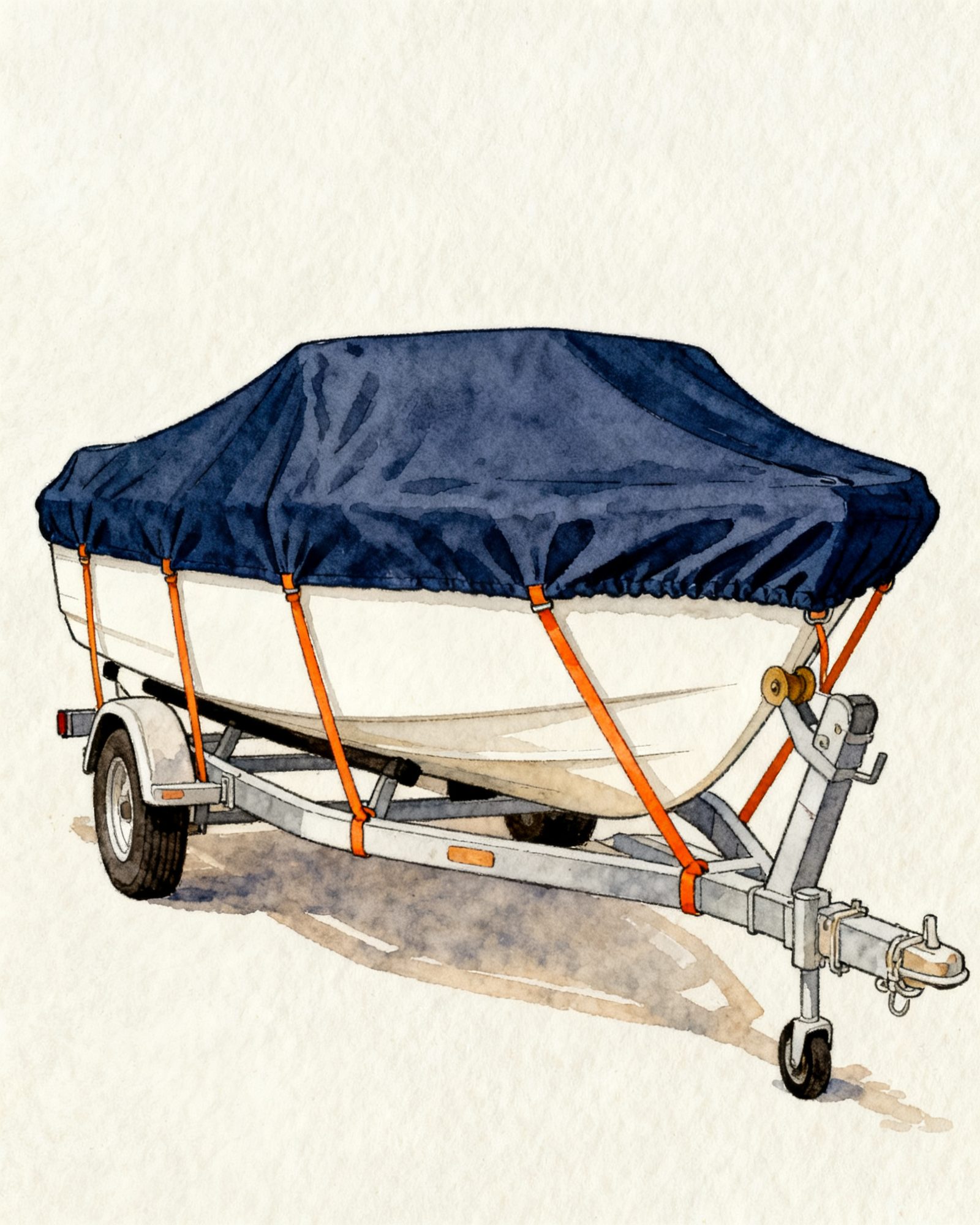
Jet ski covers: fit, trailering and winter storage
How to choose a jet ski cover that fits: measuring a personal watercraft, styled vs universal, trailerable vs storage-only, straps, drying and winter storage.
How to measure a boat for a cover: length, beam and fit
How to measure a boat for a cover: centerline length, beam at the rub rail, what to add or leave out, the heights that matter and how size charts work.
Custom, styled-to-fit or universal: which boat cover fits
Custom boat covers vs styled-to-fit and universal: how each is cut and sized, when each is the right buy, and how to find a custom fit cover for your boat.
How to tie down a boat cover for trailering
A trailerable boat cover survives the highway only when it is fitted bow first, pulled under the rub rail and strapped to the trailer frame. Steps and checks.