How to tie down a boat cover for trailering
A trailerable boat cover survives the highway only when it is fitted bow first, pulled under the rub rail and strapped to the trailer frame. Steps and checks.
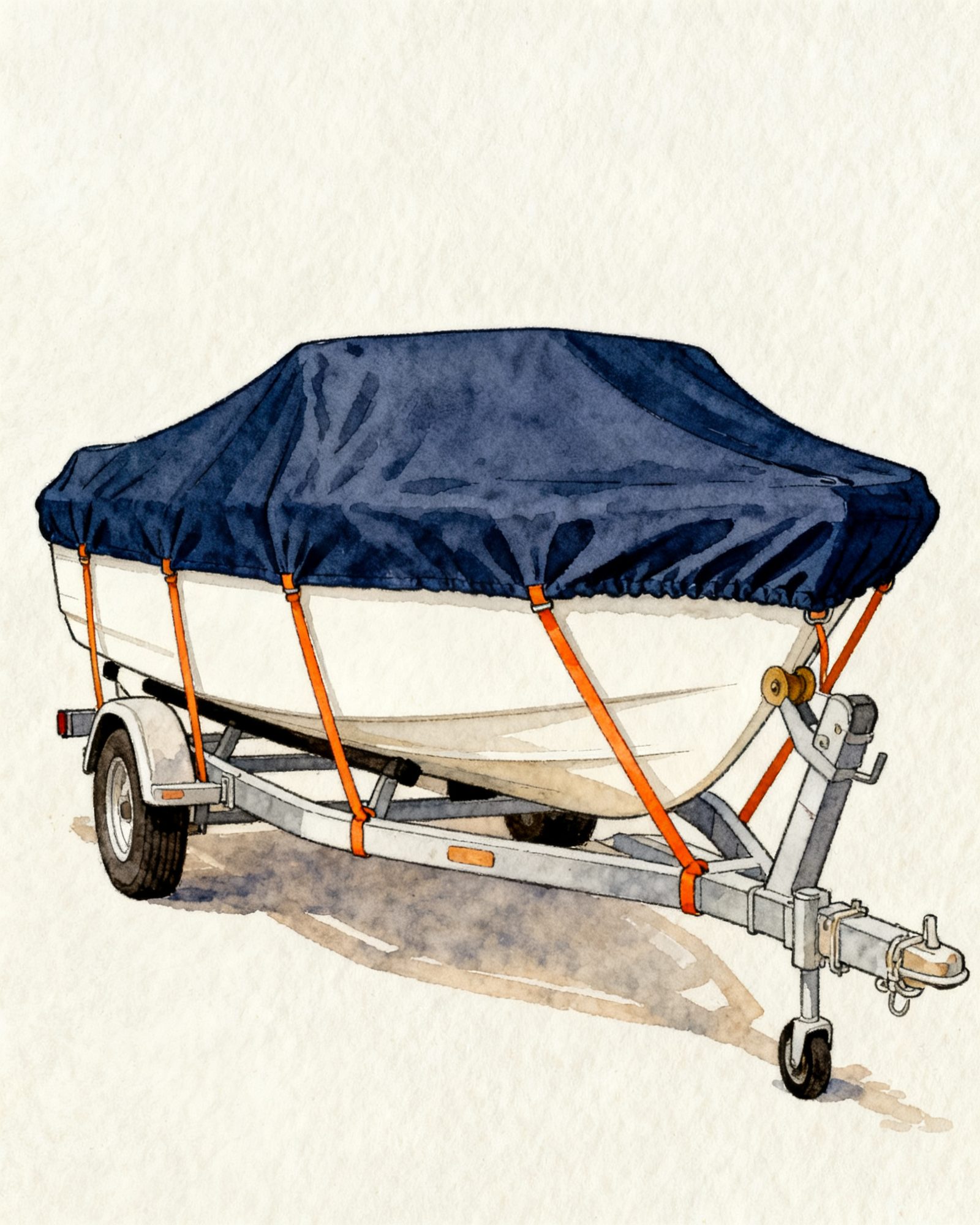
A trailerable boat cover stays on at highway speed only when three things are true: the cover was made for towing, it is fitted tight with its hem pulled under the rub rail, and every strap runs around the trailer frame and is cinched evenly. Take out the support pole and pad sharp corners, fit it bow first, buckle all the straps before tightening any, then stop after the first mile to check them. A mooring cover, a storage-only cover or a cover over a raised bimini should not be towed at all.
Which covers can be towed
The first question is not how to strap the cover but whether this cover should travel. Covers are built for different jobs, and the label usually says which.
| Cover type | How it holds on | Tow with it on? |
|---|---|---|
| Trailerable (towing) cover | Hem shock cord or drawcord plus straps to the trailer at several points | Yes, fitted and strapped as its maker describes |
| Mooring cover | Snaps or twist fasteners on the hull or deck | No: made for a boat sitting at a mooring or in a slip |
| Snap-around cover | Snaps around the hull | Only if its maker rates it for trailering; snaps can pull out |
| Storage-only cover | Drawcord, a few buckles, sometimes a frame | No, if the label says storage use only |
| Drawstring cover | A line drawn tight around the boat | Only if its maker rates it for trailering |
| Shrink wrap | Heat-shrunk film over strapping | A separate subject; see the winter guides |
BoatTest puts the difference plainly: a mooring cover is for a boat at a mooring, not for towing, while “a full canvas cover that is appropriate for towing will have tie downs or straps that attach to the trailer at multiple places.” Snap-around covers are nearly as protective and easier to use, it says, but the snaps can pull out. Some makers mark their covers outright: one cover maker’s T-top cover fabrics each carry the warning “Storage Use Only - Trailering Voids Warranty.”
If the cover is not made for towing, take it off and tow the boat open. BoatTest’s advice for that case is short: “Keep everything stowed if you plan to trailer without a cover.” Seat cushions, life jackets, lines and loose gear go below or come off the boat. The way covers are cut and sold is explained in boat cover styles compared, and mooring covers in mooring covers for boats kept in the water.
Before you fit the cover
- Lower and stow the bimini top. A raised bimini cannot go under a cover, and a folded one left loose rubs and wears on the road. One bimini maker’s guidance says to “secure the folded frame tightly before running or trailering,” using the straps or storage boot so the frame is “tight, compact, and unable to move freely.” Practical Sailor goes further for long trips: “remove dodgers and Biminis to prevent damage and chafe.” The details for each kind of frame are in trailering with a bimini top.
- Take the support pole out. Support poles hold the middle of the cover up so rain runs off while the boat is parked. On the road they are a hazard. One cover maker’s instructions say: “Remove the support pole and re-tension straps before transporting your boat.” What poles do in storage, and how to set them, is in boat cover support poles.
- Stow loose gear. Anything that can shift under the cover will rub through it from the inside.
- Pad sharp points. The same maker’s instructions say to “cover sharp points (such as the corners of your boat’s windshield) with cloth or a sponge to avoid stressing or tearing your boat cover.” Look at windshield corners, rod holders, cleats, antenna mounts, rail ends and the top of the outboard.
- Check the cover itself. A torn seam, a missing strap or a hem cord that has lost its stretch will fail at speed. Repair or replace it before the trip, not after.
Fitting the cover, bow first
- Find the front. Most trailerable covers are tapered at one end and labelled. One maker’s instructions say to “drape your cover over your boat with the tapered end that has the label marked “FRONT” at the bow.”
- Hook the bow first. Pull the bow pocket well down over the stem. A bow that is loose is where air gets in first, because it faces straight into the wind.
- Work the cover back over the windshield and cockpit, keeping it centered so the seams sit evenly on both sides.
- Pull the hem under the rub rail all the way round. The same instructions say: “Pull your cover below the rub rail around the entire boat.” A hem that sits on the side of the hull lets wind in under it.
- Tighten the hem cord or drawstring, if the cover has one, so the hem hugs the hull below the rail. What to look for: no gap you can push a hand into anywhere around the boat.
Strapping the cover to the trailer
The straps hold the cover down against the lift that wind creates at speed. They do this only if they pull from something solid and pull evenly.
- Route each strap around the trailer frame. One cover maker’s instructions describe straps running “around a trailer beam” and back up to the buckle on the cover. A cross member or the main frame rail is the right anchor.
- Keep straps off everything else. Bunks and rollers carry the hull, so a strap trapped there gets crushed and chafed. Lights and wiring can be pulled loose. Nothing should run near the wheels, fenders or brakes, where a loose strap can be caught or cut.
- Buckle all the straps first. Then tighten. The same instructions say: “After buckling ALL of the straps, cinch all straps tight and adjust their length as necessary to get a tight fit.” Tightening one strap fully before the others are buckled pulls the cover off center.
- Cinch from the bow back, a little at a time, alternating sides, so no single strap drags the cover forward or off to one side. What to look for: the cover sits centered, seams straight, with no slack folds and no strap pulling the hem up off the rub rail.
- Use every strap. The maker’s instructions for its trailerable cover say “you MUST use all the included straps”, and that skipping them invalidates that maker’s warranty. A strap left off is a section of hem free to lift.
- Tie off the tails. Excess strap left loose whips against the cover and hull for the whole trip. Tuck or knot it.
Why a loose cover beats itself to pieces
At road speed, air flows over the boat and tries to lift the cover, and any opening at the hem lets it inflate from underneath. Once the cover balloons, it flutters, and every flutter snaps the fabric against the windshield, rails and gunwale. Seams and stitching give way, the fabric wears through at the points it hits, and buckles or snaps beat against the gelcoat. The boat underneath picks up scuffs where the cover rubbed.
That is why a cover that is merely on is not good enough. A tight, centered cover with its hem under the rail gives the wind nothing to grip. If a cover still billows after it is properly fitted and strapped, it is the wrong size or the wrong type for towing, and the boat is better off travelling without it.
Checking the cover on the road
Instead of a speed limit, which no cover maker’s statement found for this guide gives, the cover maker’s instructions give a routine for checking the result.
- After the first mile. One cover maker’s instructions say: “After driving the first mile, it is a good idea to stop and check your cover to ensure that all straps are secured correctly.” Straps settle and fabric stretches in the first minutes of driving.
- In the mirror. A cover lifting at the bow or swelling along one side means a strap has slackened or the hem has come out from under the rail. Pull over somewhere safe and fix it.
- At every stop. Walk round the boat. Re-cinch any strap that has slackened, check the padding is still in place, and look for rub marks starting on the fabric.
- After the trip. Put the support pole back so water cannot pool on the parked cover, re-tension the straps around it, and let a wet cover dry before it is folded away.
When not to tow covered
- The cover is a mooring cover, a snap-on cover its maker does not rate for trailering, or labelled for storage use only.
- The bimini top or a frame is still up, or a tall canvas enclosure is in place.
- A strap is missing, a buckle is broken or the hem cord has lost its stretch.
- The cover has a tear or a failing seam that the wind will open further.
- The cover still balloons when every strap is cinched.
In any of these cases, take the cover off, stow everything inside the boat, and put the cover in the tow vehicle. The same strap-to-the-frame method applies to small craft as well; the specifics for personal watercraft are in jet ski and personal watercraft covers.
Common questions
Can you trailer a boat with the cover on?
Yes, with a cover made for trailering, fitted snugly and strapped to the trailer at every point its maker provides. One cover maker's instructions say all the included straps must be used when trailering. A mooring cover, a storage-only cover or a camping enclosure should come off, and the boat should travel with everything inside stowed.
How fast can I drive with a boat cover on?
No cover maker's instructions cited here give a maximum speed, and the limits quoted on boating forums are personal opinions. What matters is whether the cover stays tight: if it lifts, billows or a strap goes slack, slow down and pull over to fix it. Checking after the first mile and at every stop tells you more than any speed rule.
How do I stop my boat cover flapping when towing?
Flapping starts where air gets under the cover. Pull the hem below the rub rail all the way round, tighten the drawcord, add straps at the bow and the widest point, and cinch every strap evenly. If a cover still billows when it is tight, it is the wrong size or not made for towing.
Where do boat cover straps attach on a trailer?
Around a solid frame member of the trailer, such as a cross member or the main beam, and back up to the buckle on the cover. Keep them off the bunks, rollers, lights, wiring and anything near the wheels. The strap should pull the cover down and slightly inward, not sideways along the hull.
Should I leave the support pole in when towing?
No. One cover maker's instructions say to remove the support pole and re-tension the straps before transporting the boat. A pole that shifts on bumps can punch through the cover or mark the deck, and once it is out the straps need tightening again.
Sources
Read next
Jet ski covers: fit, trailering and winter storage
How to choose a jet ski cover that fits: measuring a personal watercraft, styled vs universal, trailerable vs storage-only, straps, drying and winter storage.
How to measure a boat for a cover: length, beam and fit
How to measure a boat for a cover: centerline length, beam at the rub rail, what to add or leave out, the heights that matter and how size charts work.
Custom, styled-to-fit or universal: which boat cover fits
Custom boat covers vs styled-to-fit and universal: how each is cut and sized, when each is the right buy, and how to find a custom fit cover for your boat.
Bimini tops for boats: choosing bows, frame and fabric
How to choose a bimini top: 2, 3 or 4 bows, aluminum or stainless frame, round or square tube, acrylic, polyester or vinyl fabric, mounts, boots and pontoons.
How to measure for a bimini top: width, length, height
How to measure for a bimini top: mounting width between the mounts, length front to back, frame height from the mount up, plus headroom and folding clearance.