How to measure a boat for a cover: length, beam and fit
How to measure a boat for a cover: centerline length, beam at the rub rail, what to add or leave out, the heights that matter and how size charts work.
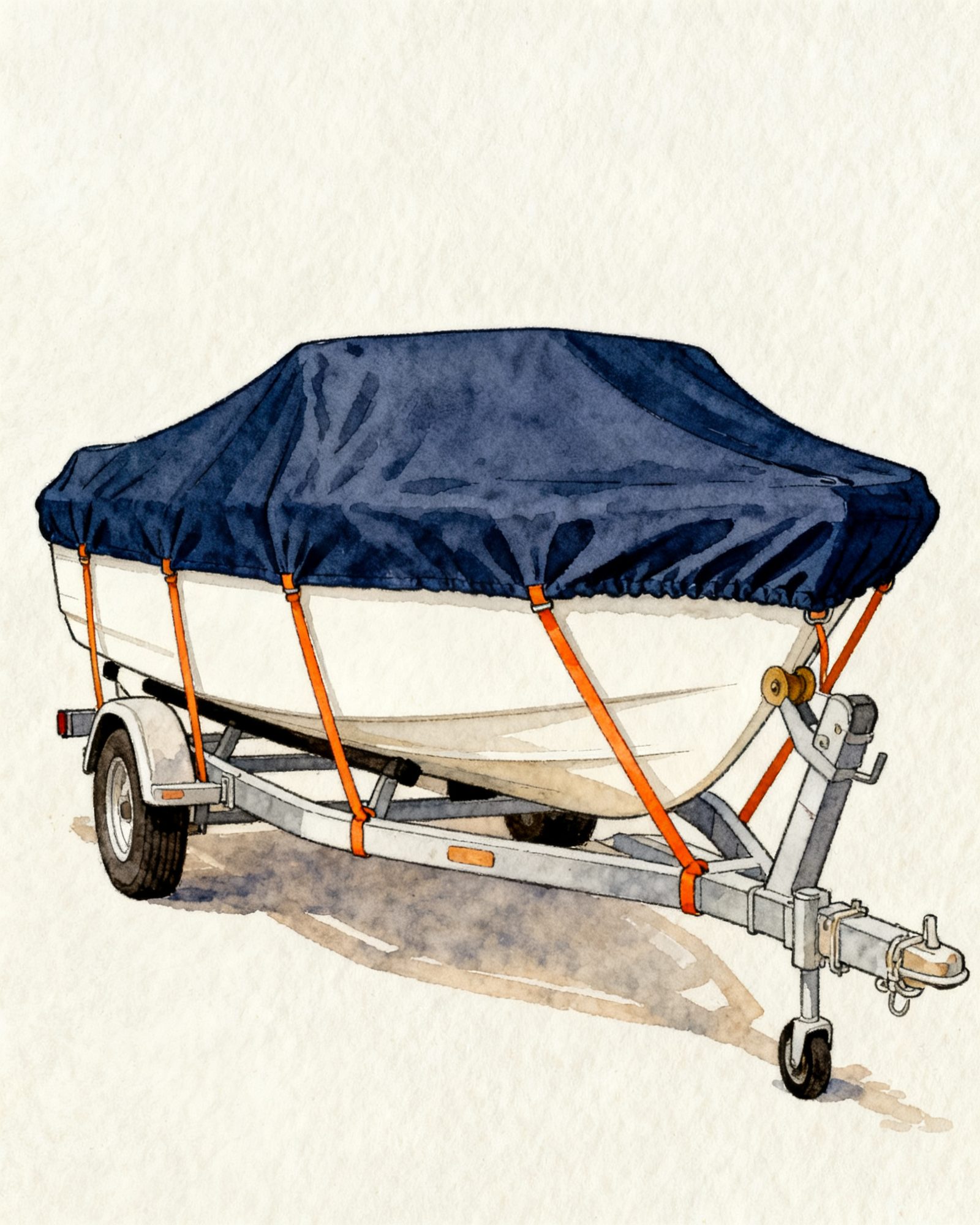
To measure a boat for a cover you need two numbers. The first is the centerline length: a straight line from the tip of the bow to the center of the stern, plus anything that sticks out past the hull and has to go under the cover, such as a bow pulpit, a transom bracket or a swim platform you want covered. The second is the beam: the widest point of the boat, rub rail included. Then write down the heights of the windshield, console and any T-top or tower, because those decide which kind of cover can fit at all. Take the numbers off the boat itself rather than from a brochure: a published length may include or leave out a platform or pulpit, so it is not always the number a cover is sold by.
What you need before you start
- A steel or other non-stretching tape measure, long enough to span the boat.
- A helper to hold the far end, so the tape stays straight.
- Two strings, each tied to a small weight, as plumb lines from the bow and stern to the ground.
- Chalk or masking tape to mark the ground, and a notepad.
- A level spot, such as a flat driveway with the boat on its trailer.
Fold down and stow a bimini top, take off any old cover, and clear loose gear from the deck.
Centerline length: what to include and what to leave out
One cover seller’s measuring guide gives the base measurement as “from the tip of the bow to the center on the stern”, then adds the length of bow pulpits and transom brackets, and swim platforms only if you want them covered. Everything else depends on what the cover has to reach over.
| Part of the boat | Add it to the length? | What to note |
|---|---|---|
| Hull, bow tip to center of the stern | This is the base measurement | Straight line, not over the deck |
| Bow pulpit | Yes | Measure to its farthest forward point |
| Transom bracket (motor set back from the hull) | Yes | Measure to the back of the bracket |
| Swim platform | Only if you want it covered | Write the length with and without it |
| Outboard motor on the transom | No | Note whether it is one motor or two |
| Sterndrive outdrive | No | Note the engine type: it changes the stern of a pattern |
| Bow-mounted trolling motor | Note it separately | Measure how far it reaches past the bow tip when stowed |
| Bow rails | No | Note their height above the deck |
| Boarding ladder | Note it separately | Note where it folds and whether it sticks out past the stern |
Measuring the centerline, step by step
- Mark the bow. Find the farthest forward point of the hull at the stem, or of the pulpit if it is included. Hang a plumb line from it and mark the ground where the weight settles. Look for: a weight that has stopped swinging, hangs just clear of the ground and does not touch the trailer tongue or winch stand.
- Mark the stern. Find the center of the transom at its farthest aft point, or the aft edge of the bracket or platform if you are including it. Hang the second line and mark the ground. Look for: the center, not a corner; a transom is often curved.
- Measure between the marks. Look for: a tape lying flat and straight on the ground, not bowed around a trailer wheel.
- Repeat it. Two readings that disagree mean one mark was off; re-hang the line.
- Write down every version. Hull alone, hull plus pulpit or bracket, and hull plus platform. Feet and inches, not rounded.
Beam: the widest point, rub rail included
The same seller’s guide says to “measure the widest point of your boat, including the rub-rail”, and offers a picture that helps: imagine the boat clamped sideways in a vise, and the beam is taken “at the points where the jaws of the vise would first contact the sides of the boat.”
- Find the widest station. Sight along the hull from the bow to see where the rub rail bulges out farthest, and check a few points, because the widest point is not always amidships.
- Square up two straight edges. Hold a long level or straight board upright against the rub rail on each side, or drop a plumb line from each rail to the ground. Look for: both edges truly vertical, so the reading is the outside of the rail and not the hull below it.
- Measure across. Measure between the two edges or the two ground marks, square to the centerline. Look for: a tape at right angles to the boat, not on a diagonal.
- Write it in inches. Many size charts list beam in inches, so 7 feet 8 inches becomes 92 inches.
Pontoons, bass boats and other shapes
On a pontoon, the cover goes over the deck and fence, so the useful numbers are the length of the deck or fence along the middle and the width across it. Sellers do not all agree on whether a pontoon size refers to the deck, the fence or the tubes, so read the chart’s note and measure what it asks for. Pontoon boat covers have their own fit questions around the fence gates and the bimini. On a bass boat or other fishing boat, write down the bow trolling motor and the console: patterns for these boats are often cut with room for them, and a cover sized only by length and beam may not be.
Heights and features that change the fit
Two boats with the same length and beam can need different covers. Measure or note:
- Windshield. Note whether it is a full wraparound or a walk-through, and measure its height above the deck. A cover cut for a low windshield will be strained tight across a tall one.
- Console. On a center console, measure the console height and where it sits between bow and stern.
- T-top, hardtop or tower. These change the job entirely: either the cover is cut to go around and under them, or the top gets its own cover. Boating magazine notes that most fitted covers “are made to fit a boat type, such as a center-console or cuddy cabin with a hardtop or a cabin cruiser”, so the hull style you name has to include the top.
- Bow rails. Measure their height; rails hold the fabric up off the deck.
- Outboard or sterndrive. Patterns are cut differently at the stern for each, so write down the engine type and whether there is one motor or two.
- Bimini top. Note where the frame folds and whether it stays on the boat folded in its boot. A cover for a boat with a bimini has to fit over the stowed frame. Measuring for the top itself is a separate job; see how to measure for a bimini top.
- Anything sharp. Antennas, rod holders, cleats and windshield corners do not change the size, but note them for padding.
What to write down
Put all of it on one sheet for the seller, a canvas shop or a size chart:
- Make, model and model year of the boat, if you know them
- Hull style (runabout or bowrider, cuddy, center console, bass boat, deck boat, pontoon, jon boat)
- Centerline length: hull only, with pulpit or bracket, with platform
- Beam at the rub rail, in inches
- Windshield type and height; console height
- T-top, hardtop, tower, bimini: yes or no, and where
- Engine: outboard or sterndrive, one or two
- Trolling motor, bow rails, ladder, and their positions
A worked example
Take a runabout whose hull measures 18 feet 4 inches from bow tip to the center of the transom, with a bolt-on swim platform that adds 1 foot 2 inches, and a beam at the rub rail of 92 inches. Its length is 18 feet 4 inches without the platform and 19 feet 6 inches with it. On an illustrative chart with sizes of 17’6” to 18’5” and 18’6” to 19’5”, the boat without the platform sits near the top of the first size and will fit snugly. With the platform it is just over the second size and lands at the short end of the next one, where the cover will be loose. So decide whether the platform is covered before you look at sizes, not after.
How sellers use the numbers
- Custom covers are patterned for one make, model and year. The maker works from the pattern, and your measurements are a check that your boat matches it.
- Semi-custom or styled-to-fit covers are cut for a hull style and sold in length ranges with a maximum beam.
- Universal covers cover a range of lengths and beams and rely on elastic in the hem and straps to pull the fabric in.
When each is the right buy is set out in custom, styled-to-fit and universal boat covers.
Reading a size chart
- Start from the hull style. Find the row for your type of boat before looking at lengths. A runabout chart and a center console chart are different patterns.
- Find the length range. Use the length that matches what you want covered, with or without the platform.
- Check the beam. Your beam must be within the size’s maximum. A boat that is unusually beamy for its length may need the next size.
- Read the notes. Charts usually say what a size assumes, such as windshield type, engine or platform. A feature they do not mention is a question for the seller.
- Ask when you are on a boundary. If your length lands right on the line between two sizes, ask which one the pattern is cut for.
The seller quoted above says its semi-custom covers adjust to fit the beam and centerline “plus or minus 4 inches”; that is one seller’s tolerance, not a rule.
Why a range cover fits loosely at the short end
A cover sold for a range has to fit the longest and widest boat in it, so it is cut for the long end. On a boat at the short end, the extra fabric gathers at the stern and sides. That slack lets wind get under the cover and makes it flap on the trailer, which wears the fabric and the boat. It also forms low spots where water collects. In the BoatUS Foundation’s winter cover trial, reported by BoatTEST, water collecting in covers loaded the straps and buckles, and the covers often needed bailing after rain or snow. Pulling the straps tight takes up some slack, and support poles that stop water pooling take up more, but neither turns a loose cover into a fitted one.
Checking the fit when the cover arrives
- Wait if the boat is new. One cover maker’s instructions say its cover is not recommended within the first four weeks of owning a new boat, because “some compounds used in new boats can release gases that will cause the dyes in boat covers to transfer to the boat.”
- Pad the sharp points. The same instructions say to cover sharp points such as the corners of the windshield “with cloth or a sponge” so they do not stress or tear the cover.
- Start at the bow. Put the end marked as the front at the bow, then pull the cover “below the rub rail around the entire boat.” Look for: a hem that sits evenly below the rail all the way round.
- Look for strain and sag. Tight windshield corners mean the cover is too short or cut for a lower windshield; hollows behind the windshield mean it needs support.
- Strap it and check it. BoatTEST notes that a full cover suitable for towing has tie-downs or straps that attach to the trailer in several places. Fitting the straps properly is covered in how to tie down a boat cover for trailering. Some covers, such as one maker’s T-top covers marked “Storage Use Only - Trailering Voids Warranty”, are not made to be towed at all.
When to stop measuring and call a canvas shop
A tape and a size chart work for boats close to a standard shape. They are the wrong tool for a tower or T-top added after the boat left the factory, an unusual console, an old hull with no pattern on file, or a cover that snaps to the hull. A marine canvas shop patterns directly on the boat instead. Whatever the cover, the fabric decides how long it lasts: see boat cover fabrics compared before choosing one.
Common questions
How do I know what size boat cover I need?
Your size is the combination of hull style, centerline length and beam, read against the seller's chart for that style of cover. If your boat has a pattern of its own, the make, model and year decide the cover and your tape measurements only confirm it. When your length lands right on the line between two sizes, ask the seller which one their pattern is cut for rather than guessing.
Do you include the outboard motor when measuring for a boat cover?
No. The centerline stops at the center of the stern, and the motor is not added. What does get added is a transom bracket that sets the motor back from the hull. How the cover's stern fits around the motor depends on its pattern, so check the description for your engine type before ordering.
Should I measure over the windshield?
Not for the length. Covers are sold by a straight-line length, and running the tape up and over the windshield adds inches that the cover does not need, which pushes you into a size that is too big. Measure the windshield height separately and use it to decide whether a cover style is cut tall enough for your boat.
How do you measure a pontoon boat for a cover?
Lower and stow the bimini first. Then write down both the deck length and the fence length along the middle, and the width across each, so you can give whichever number a seller's chart asks for. Note where the gates and the bimini frame sit, because the cover has to fit over them.
Can I measure a boat while it is in the water?
Beam is hard to measure on the water and a plumb line cannot reach the ground, so a boat on its trailer or on a level surface gives a far better reading. In a slip, measure the length along the dock with the boat held parallel and close, and repeat the reading when the boat is next out of the water.
Sources
Read next
Custom, styled-to-fit or universal: which boat cover fits
Custom boat covers vs styled-to-fit and universal: how each is cut and sized, when each is the right buy, and how to find a custom fit cover for your boat.
Jet ski covers: fit, trailering and winter storage
How to choose a jet ski cover that fits: measuring a personal watercraft, styled vs universal, trailerable vs storage-only, straps, drying and winter storage.
How to tie down a boat cover for trailering
A trailerable boat cover survives the highway only when it is fitted bow first, pulled under the rub rail and strapped to the trailer frame. Steps and checks.
How to measure for a bimini top: width, length, height
How to measure for a bimini top: mounting width between the mounts, length front to back, frame height from the mount up, plus headroom and folding clearance.
Bimini tops for boats: choosing bows, frame and fabric
How to choose a bimini top: 2, 3 or 4 bows, aluminum or stainless frame, round or square tube, acrylic, polyester or vinyl fabric, mounts, boots and pontoons.