How to Shrink Wrap a Boat for Winter, Step by Step
How to shrink wrap a boat yourself: the support frame, perimeter band, heat welding, vents and doors, fire and carbon monoxide safety, and recycling in spring.
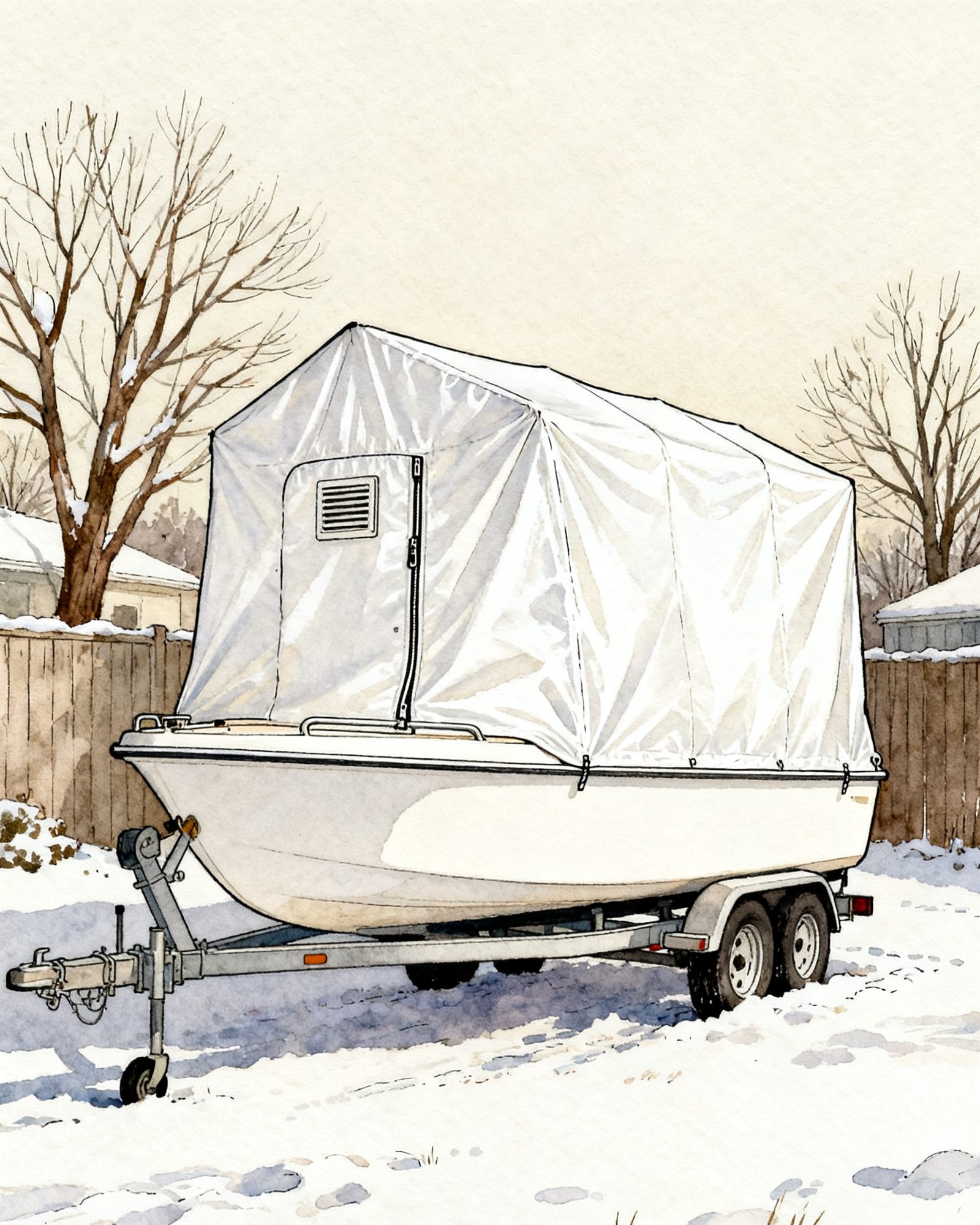
To shrink wrap a boat, you build a support frame with a ridge that sheds snow and rain, run a strap (the perimeter band) around the hull below the rub rail, drape plastic film over the boat, heat-weld its hem around that band, add belly bands underneath, shrink the film tight with a heat tool, then fit vents and an access door. On a small, simple boat an owner can learn it; otherwise it belongs to a yard. The hazards are the heat tool, which can set the film on fire, falls from the ladder, and carbon monoxide trapped under a wrapped boat.
Before you start: wrap it yourself or hire it out?
Boating magazine sums up the choice: doing your own wrap makes sense if you are “handy with a heat gun and plan to do it every season”, or if you go in with a group of boaters to share the tools and labor; otherwise it is “best left to the yard”. Discover Boating, the boat industry’s consumer site, calls a professional job “by far the best way to cover a boat for winter storage”.
- Do it yourself when the boat is small and simple in shape, you can reach the whole top from a step ladder, you have a helper, and you can handle a propane tank safely.
- Hire it out when the boat has a tower, arch, T-top or flybridge, or sits close to other boats in a crowded yard. The US fire standard for marinas and boatyards, NFPA 303, in the edition its committee reviewed in 2023, says shrink-wrap operations and the devices used for them “shall be approved”, so ask the yard before you arrive with a heat tool.
On cost: Boating magazine notes that yards quote per foot of boat length and that flybridges, radar arches and other appendages typically raise the price. Doing it yourself means buying a heat tool once and new film, strapping, tape and vents every year; the factors are in what boat shrink wrap costs and why.
Still deciding whether to wrap at all? Read the comparison of a boat cover and shrink wrap first.
What you need
Boat kits bundle most of this; one shrink-wrap maker’s kit leaves the owner to supply the propane tank, ladders, a tape measure, a handsaw, a ring cutter, lumber and a stapler.
- Shrink-wrap film on a roll wide enough for the boat (measuring is below). Film comes in several thicknesses; use the one the film maker recommends for the boat’s size and your winter.
- Strapping for the perimeter band, belly bands and ridge; shrink-wrap tape; self-adhesive vents and a zipper door.
- Support posts: one maker uses 2x4 boards cut to length as uprights (at most six 8-foot boards; smaller boats take fewer), stapled to the strapping with 1/2-inch staples, plus foam padding for sharp corners.
- A propane heat tool made for shrink wrap.
- A propane tank: the maker’s list calls for a 20 pound tank, the size used on a home barbecue.
- A sturdy ladder (see the ladder section below) and a tape measure.
- Safety gear: a fire extinguisher, safety glasses, and gloves. The heat-tool maker’s guide suggests flame-retardant or leather gloves; Boating magazine adds long sleeves and a welder’s glove on the hand opposite the gun.
Measure for the film width
A shrink-wrap maker’s instructions give this method for a recreational boat: start at the highest point (the top of the support post), measure over the widest part of the boat down to about 8 inches below the rub rail, double that figure and add 2 feet. The result is the narrowest roll that will work. Measure with the posts set up, or from where their tops will be; the maker says each boat must be measured rather than sized from a chart.
A worked example: if the tape reads 6 feet 8 inches from the top of the post to the rub rail, add the 8 inches below it for 7 feet 4 inches; that doubles to 14 feet 8 inches, and adding 2 feet gives 16 feet 8 inches. Choose the next roll width up. For the length, take the overall length, including any swim platform, pulpit or outboard, and add the same drop past the rub rail at the bow and at the stern.
How to shrink wrap a boat, step by step
Pick a calm, dry day: the heat-tool maker’s guide says not to shrink wrap outdoors when the wind is harder than 10 mph. Finish every job that needs someone inside the boat first, including engine winterizing (the engine maker’s manual or a marine mechanic covers that).
- Prepare the boat. Clean and dry it; Discover Boating notes that dirt and grease promote mildew. Store cushions, fabric items and life jackets somewhere warm and dry, and remove all food and trash.
- Tape over the fuel vents and pad the sharp points. A shrink-wrap maker’s instructions call for taping over the fuel vents before wrapping; Boating magazine explains it helps prevent igniting any fuel vapors. Pad windshield corners, cleats, rails and anything sharp with foam, tape or towels.
- Build the support frame. Set wooden uprights or posts and run a strap fore and aft over them to make a ridge, so snow and rain run off instead of pooling. A shrink-wrap maker’s diagram shows a minimum of 1 support post for every 6 feet of length. Each post must stand on something solid.
- Fit the perimeter band. Run strapping around the whole boat below the rub rail and pull it snug. This is the hem the film is welded to. On a pontoon, the same instructions reverse the order: the film goes on first and the perimeter band is installed over it, just below the decking.
- Drape the film. Unroll the film over the boat with a helper on the other side. Keep it off the ground: the maker’s instructions explain that static draws dirt onto film that drags, and dirty film will not weld properly.
- Weld the hem and add the belly bands. Bring the film’s lower edge under and around the perimeter band and heat-weld it all the way around. Then fit the belly bands at once, as the instructions require: straps running under the hull from side to side that pull slack out of the film so it shrinks tighter.
- Seal the pleats. Gather the extra film at the bow and stern into neat pleats and heat-seal them.
- Shrink the film. Before your first wrap, Boating magazine suggests practicing on a wood or plastic box to get a feel for how close is close enough. Begin at the bottom of the cover near one end, never in the middle, and sweep the heat along to the other end up to the rub rail, moving the tool the way you would use a spray can. Then shrink the top. Keep the tool moving, and keep the heat off corners and sharp points so the film keeps its full thickness there.
- Patrol for holes. Look over the whole wrap for burn holes and punctures. Patch each one with shrink-wrap tape, rub the tape to remove air bubbles, and warm it lightly with the gun.
- Fit vents and the door. Do this only after shrinking is complete; vents and doors are never heated. Before cutting an opening, push on the film to check nothing, such as a cushion, sits behind it. Warm the vent’s adhesive by hand and rub it down. Tape the door on with shrink-wrap tape, unzip it, and cut the film inside the zipper.
- Shut down and check. Turn off the propane tank and purge the gas from the hose, as the heat-tool maker’s guide directs after every job. Remove the tape from the fuel vents. Then stay and watch the boat for a while (see the fire section below).
How many vents?
A shrink-wrap maker’s instructions say every wrap must be ventilated against moisture, condensation and mildew, and that it is better to over-ventilate than fit too few. Its guide:
| Boat length | Vents and where |
|---|---|
| Up to 18 feet | 3: two behind the windshield, one at the rear of the cockpit |
| 19 to 24 feet | Two at the rear of the cockpit, two forward of the windshield |
| 25 to 32 feet | Two at the rear of the cockpit, two midships, two near the bow |
| 33 to 42 feet | Two at the rear of the cockpit, two on the flybridge, two midships, two near the bow |
| 43 feet and up | As above, with extras along the sides |
In areas with heavy snow, the same instructions say to mount vents vertically so snow is less likely to cover them.
Sailboats and pontoons
On a sailboat with the mast down, the same instructions put an upright in the cockpit and then one every 5 to 6 feet to the bow, with the center strap at least 18 inches above the stanchion tops.
Fire safety with the heat tool
A shrink-wrap maker’s instructions warn that the film can burn, “can ignite into open flame”, and can drop onto material below and start a second fire. If you see the film burning, stop at once and check the area for fire. Keep a fire extinguisher at hand at all times.
The heat-tool maker’s safety guide adds: keep the work area clear of debris, wood shavings, paper and flammable chemicals; check the fittings for leaks and the hose for cracks or loose connections; never hold heat on one spot for more than a few seconds, because the film keeps shrinking after the heat moves away; never aim the tool at an area you cannot see; no loose clothing, long hair tied back; and good ventilation when working indoors. Boating magazine adds safety glasses against hot air blowback and rare drips of hot plastic.
The committee that writes NFPA 303 treats shrink wrapping as a hot-work-like job and has considered measures such as wrapping in an open area well away from other combustible material, checking that fuel filler caps are closed tight, a fire watch, and watching the boat after the work, because a hot spot can become a smoldering fire. Those are draft proposals, not current rules, but staying with the boat afterward costs nothing. Always follow the tool’s and the film’s own instructions.
Ladders and falls
The maker’s instructions call for a sturdy step ladder tall enough that you never stand on the upper rungs, or an extension ladder on larger boats with a flybridge. The heat-tool guide says not to overreach and to keep proper footing and balance at all times. Move the ladder rather than leaning out, and never climb onto the wrapped top.
Carbon monoxide under a wrap
The US Coast Guard lists “inadequately ventilated canvas enclosures” and “exhaust gas trapped in enclosed places” among the ways carbon monoxide builds up on boats, and warns it can stay at dangerous levels after an engine has stopped. The CDC calls it an odorless, colorless gas that kills without warning; headache, dizziness, weakness, upset stomach and vomiting are its most common symptoms.
A Maryland legislative fiscal note on a 2018 bill describes a worker who, in November 2016, winterized a boat that had already been shrink-wrapped (winterizing typically involves idling the engine) and died of carbon monoxide overexposure. The bill would bar boat-winterizing businesses from wrapping a boat until all winterizing work that needs someone inside is complete; the note does not say whether it became law. For owners: finish every engine job first, never run an engine, generator or fuel-burning heater under the wrap, and open the door to air the boat before climbing in. More is in shrink-wrap safety: heat tools, fire and falls.
Through the winter: holes, snow and mice
Check the boat after storms for loose vents and holes. A shrink-wrap maker notes that a hole will not tear or rip but lets weather in, so tape it as in step 9. Keep the vents clear of snow.
A wrap does not keep mice out on its own. Discover Boating advises leaving no food, crumbs or trash aboard, patching holes with steel wool, wire mesh or caulk, and using vents too small for mice to squeeze through; if rodents are already aboard, set traps near the engine compartment and food storage and check them regularly.
Taking it off and recycling it in spring
Boat shrink wrap is low-density polyethylene (LDPE). Woods Hole Sea Grant notes that it cannot go in curbside bins, and its Cape Cod program accepts wrap only with the strapping, vents and zipper doors removed. Its tip is to cut the plastic around the belly of the boat so the straps fall away; then strip the vents and door, keep the film clean and dry, and fold and roll it. Boating magazine notes that reputable yards recycle it; otherwise ask your marina, the film dealer or a Sea Grant office where wrap is collected. The full method is in recycling boat shrink wrap.
Common questions
Can I shrink wrap my boat myself?
Yes, if you can work safely with an open-flame propane heat tool from a ladder. Plan on help: Boating magazine notes you may need a few extra hands to get the film straight around the boat without bunching. If the boat is at a marina or boatyard, ask before you bring a heat tool, since the US fire standard for those sites requires shrink-wrap operations to be approved.
Do I need to winterize the engine before shrink wrapping?
Yes. Do every job that needs someone inside the boat, and above all anything that runs the engine, before the wrap goes on. A Maryland legislative fiscal note describes a yard worker who died of carbon monoxide overexposure in 2016 after winterizing a boat that had already been shrink-wrapped. The engine work itself belongs to the engine maker's manual or a marine mechanic.
How many vents does a shrink-wrapped boat need?
Counted from a shrink-wrap maker's chart: 3 vents up to 18 feet, 4 from 19 to 24 feet, 6 from 25 to 32 feet and 8 from 33 to 42 feet, with extras along the sides on larger boats. Spread them from the forward end to the rear of the cockpit, as the chart does, so air flows through the whole boat, and add more rather than fewer.
Does shrink wrapping a boat cause mold?
The film itself does not, but it does not breathe, so moisture trapped under a wrap with too few vents can feed mold and mildew. Discover Boating calls adequate air circulation the best way of combating mildew and notes that dirt and grease promote it, so wrap a clean, dry boat and vent it generously.
Can boat shrink wrap be reused next year?
Boating magazine calls shrink wrap single-use, and it is normally cut off in spring. Woods Hole Sea Grant's recycling program site does carry a video on how to re-use shrink wrap for multiple seasons. Wrap that is not reused should go to a shrink-wrap recycling program rather than the trash.
Sources
Read next
Boat Cover vs Shrink Wrap: Which Is Better for Winter?
Boat cover vs shrink wrap for winter: snow, ventilation and mildew, winter access, seasons of use, waste and cost factors, and how storage and climate decide it.
Boat cover fabrics compared: polyester, acrylic and canvas
Boat cover fabric explained: polyester, solution-dyed acrylic, cotton canvas and vinyl-coated polyester, denier vs ounces, waterproof vs breathable, labels.
Jet ski covers: fit, trailering and winter storage
How to choose a jet ski cover that fits: measuring a personal watercraft, styled vs universal, trailerable vs storage-only, straps, drying and winter storage.
How to measure a boat for a cover: length, beam and fit
How to measure a boat for a cover: centerline length, beam at the rub rail, what to add or leave out, the heights that matter and how size charts work.
Custom, styled-to-fit or universal: which boat cover fits
Custom boat covers vs styled-to-fit and universal: how each is cut and sized, when each is the right buy, and how to find a custom fit cover for your boat.